Mr. Wu, a 42-year-old man, began experiencing persistent pain and discomfort in his left lower abdomen and testicle without any apparent cause eight months ago. Initially, he thought it was a common inflammation and didn't pay much attention, but his symptoms didn't ease; instead, they gradually worsened.
In February 2026, Mr. Wu visited a local hospital for a check-up. An abdominal CT scan revealed multiple enlarged retroperitoneal lymph nodes, highly suggestive of metastatic lymph node tumors. To determine the exact cause, he underwent a biopsy. The pathological results confirmed a diagnosis of testicular embryonal carcinoma, plunging Mr. Wu and his family into deep anxiety.
Clinging to a glimmer of hope, Mr. Wu traveled to a major hospital in Guangzhou for further consultation. A subsequent PET-CT scan revealed concerning findings: firstly, the left testicle showed increased volume, uneven density, and mildly elevated metabolism, confirming a malignant tumor; secondly, multiple enlarged lymph nodes with increased metabolism were found in areas including the left iliac vessel region, presacral region, retroperitoneum, bilateral supraclavicular regions, left upper mediastinum, and left neck root, indicating widespread systemic lymph node metastases.
The local physician informed Mr. Wu that due to the extensive systemic metastases, surgical resection was no longer a viable option. The conventional approach would be solely systemic chemotherapy, which requires a long treatment cycle, causes significant side effects, and offers uncertain long-term efficacy. Upon hearing this, Mr. Wu's spirits plummeted. He was consumed by pain and confusion, feeling lost and nearly abandoning all hope for treatment.
Just when he felt he was at a dead end, a fellow patient recommended the Luo Pengfei · Wang Jian Interventional Research Team at the Fifth Oncology Department of Guangdong Pharmaceutical University Guangzhou Fosun Chancheng Hospital (Xinshi Hospital), renowned for their expertise in minimally invasive interventional treatments for advanced-stage cancers. Mr. Wu successfully secured an appointment with a specialist and was admitted for treatment in March 2026.
The Fifth Oncology Department at our hospital has long been dedicated to the clinical practice and research advancement of the "Luo Pengfei Programmatic Tumor Inactivation Therapy," a distinctive treatment approach encapsulating the team's extensive diagnostic and therapeutic wisdom. In recognition of Professor Luo Pengfei's outstanding contributions to interventional oncology research, the Guangdong Provincial People's Government awarded him the Third Prize for Scientific and Technological Progress in Guangdong Province in April 2001 (Certificate No.: 2000-J-3-R01-X160, Project Title: Programmatic Study of Interventional Therapy for Primary Liver Cancer), which established the professional foundation for the team's programmatic interventional diagnosis and treatment.
Upon Mr. Wu's admission, Professor Wang Jian led the research team in conducting an immediate multidisciplinary consultation. Considering the stage of his disease, the extent of metastasis, and his physical condition, they tailored a systematic and individualized minimally invasive interventional plan. Adhering to the principles of "comprehensive layout, tackling each issue, and advancing step by step," the plan aimed to target and eliminate tumor foci in different parts of the body.
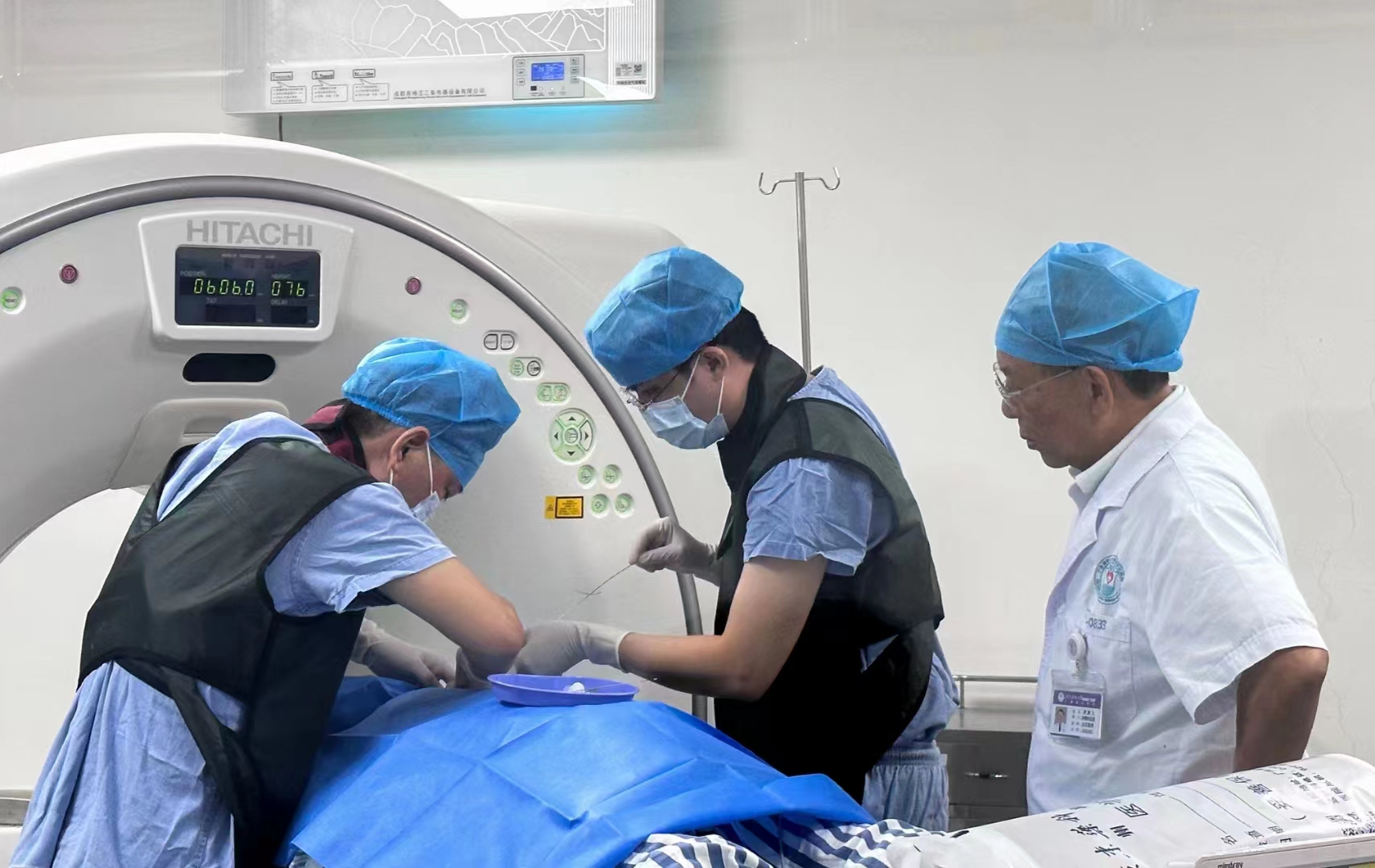
Earlier this month, Mr. Wu successfully completed six sessions of standardized treatment. Strictly following the established plan, the team employed a dual-effect minimally invasive approach combining "vascular intervention + radioactive seed implantation" to target the primary lesion in the left testicle and the multiple systemic metastatic lesions. The vascular intervention involved infusing high-concentration, low-dose chemotherapy drugs directly into the tumor's feeding arteries, followed by vascular embolization to completely cut off the tumor's blood supply, causing tumor cells to gradually necrotize due to lack of nutrients. Concurrently, seed implantation precisely placed tiny radioactive seeds into lymph node metastases with less blood supply, continuously releasing radiation to directly kill the tumor cells. This dual action precisely controlled the tumors.
Professor Wang Jian explained that testicular embryonal carcinoma is highly malignant, aggressively invading local tissues and blood vessels, and prone to early metastasis. Traditional treatment primarily relies on systemic chemotherapy. However, the comprehensive interventional approach adopted by the team directly targets the core lesions. It first uses vascular intervention to shrink the tumor volume, followed by seed implantation to eliminate residual foci. As a minimally invasive treatment, it results in less patient discomfort and fewer side effects, opening a new treatment pathway for patients with advanced testicular embryonal carcinoma.
Following the refined and programmatic treatment provided by the Luo Pengfei · Wang Jian Interventional Research Team, Mr. Wu's pain in his left lower abdomen and testicle has significantly eased, and his quality of life has greatly improved.
A recent follow-up PET-CT scan showed that the multiple metastatic lesions and the primary tumor had all significantly shrunk, indicating the disease is effectively under control. This has rekindled Mr. Wu's hope for recovery.